Skip to content
OMNI Platform

Blog

Blog / Supplements
Supplements

The Most Science-Backed Supplements

📅 July 2025 ⏱ 7 min read 🔬 Evidence-based

The supplement industry generates over $150 billion a year and is full of exaggerated claims. Yet a small but solid subset of supplements has dozens or hundreds of randomized controlled trials (RCTs) confirming both safety and efficacy in humans.

This guide focuses exclusively on those. No speculative theories, no mouse studies — only supplements with a genuine clinical evidence profile, along with the doses and mechanisms that explain why they work.
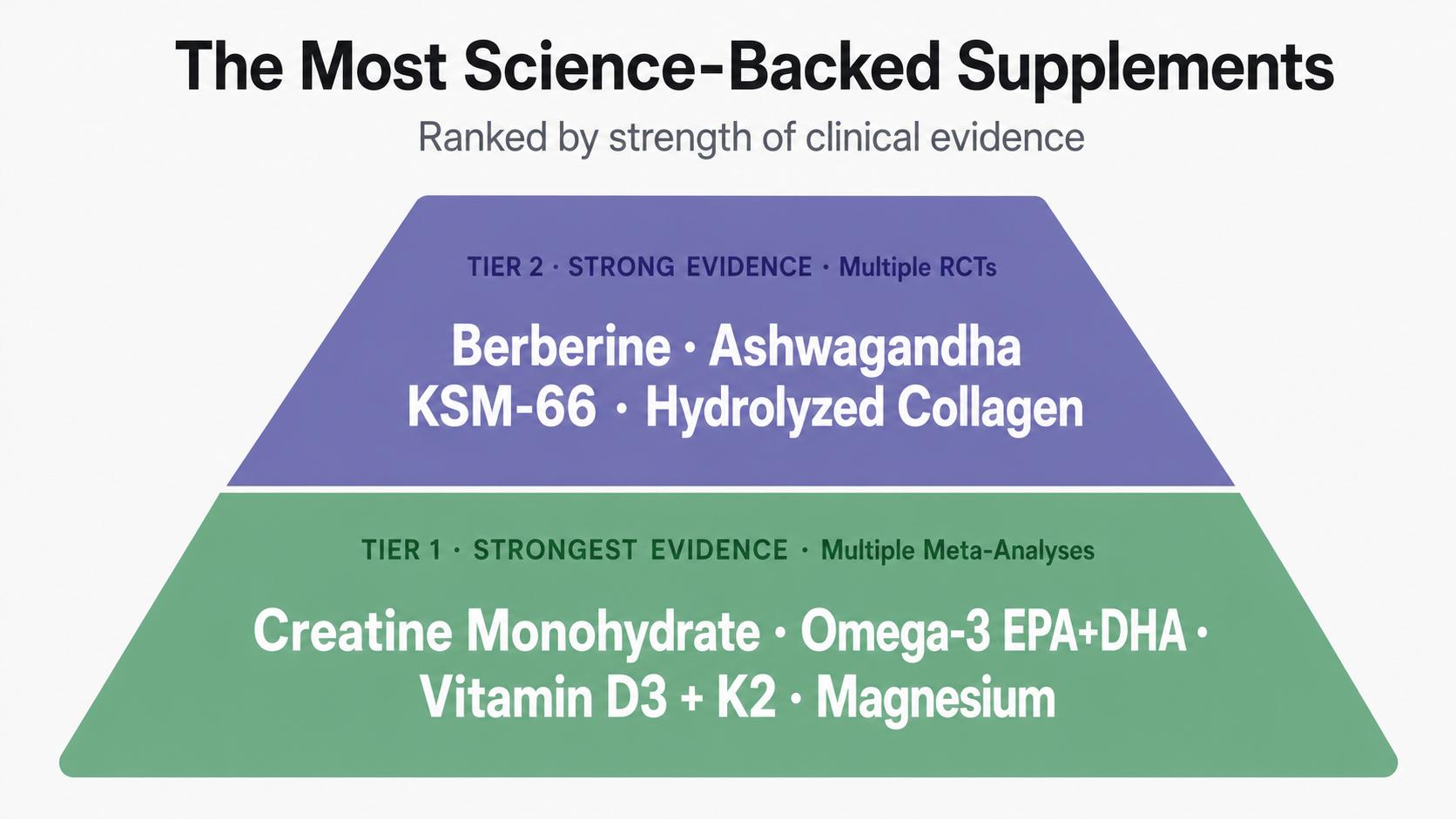
Supplement evidence pyramid
Tier 1 · Strongest Evidence
Multiple meta-analyses

Supported by multiple meta-analyses of RCTs and decades of safe clinical use.

Creatine Monohydrate
Strength · Power · Cognitive function
Tier 1
Typical dose
3–5 g / day
Best form
Monohydrate (most studied)
Time to effect
2–4 weeks of loading
Best for
Strength, muscle mass, memory in 55+
What the science says: With over 500 published studies, creatine is the most researched sports supplement in history. Meta-analyses show strength gains of an additional 5–15% over training alone. Recent research also documents improvements in working memory and processing speed in older adults, making it one of the few nootropics with solid evidence.
Omega-3 (EPA + DHA)
Heart · Brain · Inflammation
Tier 1
Typical dose
1–3 g EPA+DHA / day
Best form
rTG form fish oil or krill oil
Time to effect
4–8 weeks
Best for
Triglycerides, cardiovascular health, cognition
What the science says: Hundreds of RCTs and multiple meta-analyses confirm omega-3s reduce triglycerides by 15–30%, lower inflammation markers (IL-6, CRP), and are associated with reduced cardiovascular event risk in people with elevated triglycerides. The REDUCE-IT trial (2018) at a pharmacological 4 g/day dose showed a 25% reduction in major cardiac events.
Vitamin D3 + K2
Bones · Immunity · Mood
Tier 1
Typical dose
2.000–4.000 UI D3 + 100 µg K2 / day
Best form
D3 (colecalciferol) + K2-MK7
Time to effect
8–12 weeks to normalize levels
Best for
People with deficiency (most), low sun exposure
What the science says: Over 40% of the global population has suboptimal vitamin D levels. Meta-analyses show correcting deficiency reduces respiratory infection risk, improves bone density, and is associated with lower rates of seasonal depression. K2-MK7 is paired with D3 to direct calcium to bones and away from arterial walls, an effect documented in the Rotterdam cohort study.
Magnesium
Sleep · Stress · Muscle recovery
Tier 1
Typical dose
300–400 mg / day (evening)
Best form
Glycinate or malate (best absorption)
Time to effect
1–3 weeks
Best for
Sleep quality, cramps, stress, energy metabolism
What the science says: Magnesium is involved in over 300 enzymatic reactions in the body. Studies show supplementation improves sleep quality (increased slow-wave sleep), lowers blood pressure in hypertensives, improves insulin sensitivity, and reduces muscle cramps. Over 50% of Western populations consume below the recommended daily amount through diet alone.
Tier 2 · Strong Evidence
Multiple RCTs

Supported by multiple good-quality human trials, with clear efficacy in specific populations.

Berberine
Blood glucose · Lipids · Longevity
Tier 2
Typical dose
500 mg × 2–3 / day (with meals)
Mechanism
Activates AMPK, similar to exercise and metformin
Time to effect
4–8 weeks
Best for
Elevated glucose, insulin resistance, LDL cholesterol
What the science says: A 2012 meta-analysis in the Journal of Ethnopharmacology across 27 RCTs found berberine reduces HbA1c by 0.71% — comparable to some oral antidiabetics — and lowers LDL-C by 0.65 mmol/L. It activates AMPK (the same pathway activated by exercise and metformin) and may improve gut microbiota composition.
Ashwagandha (KSM-66)
Cortisol · Stress · Testosterone
Tier 2
Typical dose
300–600 mg / day (KSM-66 extract)
Mechanism
Adaptogen — modulates HPA axis, lowers cortisol
Time to effect
4–8 weeks
Best for
Chronic stress, sleep, elevated cortisol levels
What the science says: Multiple double-blind RCTs using the KSM-66 extract show cortisol reductions of 20–30% and statistically significant improvements on Perceived Stress Scale (PSS) scores. A 2019 trial published in Medicine also documented a 15% increase in free testosterone and improved sleep quality measured by actigraphy.
Hydrolyzed Collagen Peptides
Joints · Skin · Connective tissue
Tier 2
Typical dose
10–15 g / day
Best form
Hydrolyzed peptides type I & III
Time to effect
8–12 weeks
Best for
Joint pain, skin elasticity, tendons
What the science says: A 2021 meta-analysis in Nutrients (15 RCTs) found hydrolyzed collagen reduces joint pain at rest and during activity in active individuals. Dermatological studies show measurable improvements in skin elasticity and water content after 8–12 weeks. Taking collagen with vitamin C boosts endogenous collagen synthesis.

How to Track Your Supplement Protocol in OMNI

Tracking adherence is what turns a good protocol into real results.

1
Add your supplements in the Medicines section
Go to Medicines / Supplements and create an entry for each supplement: name, dose, unit, and frequency. You can add the brand and extra notes.
2
Create a protocol and add supplements with schedules
Protocols let you group supplements with their daily schedule. OMNI will send you a notification at the set time to confirm whether you took it or not.
3
Tap Yes / No on the daily notification
Each confirmed or declined dose is automatically recorded in your adherence history with exact date and time.
4
Review your weekly adherence and available stock
The weekly adherence view shows which days you took each supplement. Stock management alerts you when you are running low on a product.
✅ How to Choose a Quality Supplement
  • Look for third-party certifications. NSF Certified for Sport, Informed Sport, or USP verify the product contains what it claims and is free of contaminants.
  • Choose the most studied form. For creatine: monohydrate. For magnesium: glycinate or malate, not oxide. For omega-3: re-esterified triglyceride (rTG) form, not ethyl ester.
  • Label dosing vs. evidence dosing. Check that the product dose matches the dose used in clinical trials. Many products use sub-therapeutic amounts.
  • Standardized extracts for botanicals. For ashwagandha, look specifically for KSM-66 or Sensoril extract with the withanolide percentage stated.
  • Fewer ingredients is better. Supplements with long blended ingredient lists (proprietary stacks) often contain insufficient doses of each component.
⚠️ What Supplements Cannot Do

The supplements on this list build on a solid foundation — they do not replace one. Poor sleep, no exercise, a chaotic diet, and chronic stress have a far greater impact on health than any pill. Additionally, some of these supplements have significant drug interactions (berberine with metformin or anticoagulants, high-dose omega-3 with blood thinners). Always check with your doctor before starting any new protocol, especially if you take medication.

Ready to build your protocol?

Add your supplements to OMNI, set your schedules, and track your adherence week by week.

Create your free account ->